
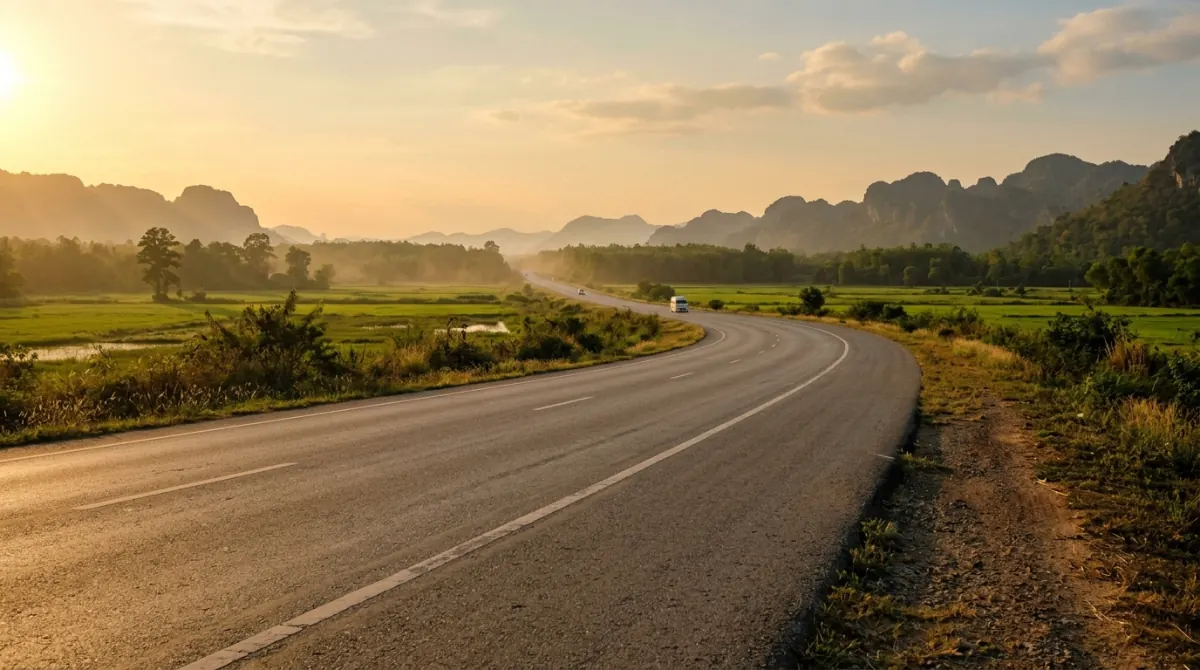
Kanchanaburi has no airport and no direct public transport from either Bangkok airport, so arriving means a road journey of about 130 km. Allow 2.5–3 hours door to door from Suvarnabhumi, 2–2.5 from Don Mueang. Minivans run all day from two Bangkok terminals. The Thonburi train is a scenic ride, not a way to arrive.
At a glance
| Distance, central Bangkok → Kanchanaburi town | ~130 km |
| Distance, Suvarnabhumi (BKK) → Kanchanaburi town | ~155 km |
| Distance, Don Mueang (DMK) → Kanchanaburi town | ~135 km |
| Bangkok terminals for minivans | Sai Tai Mai (Southern Bus Terminal) and Mochit New Van Terminal |
| Bangkok station for trains | Thonburi, also called Bangkok Noi — not Hua Lamphong or Krung Thep Aphiwat |
| Minivan fare from Bangkok | 110–150 THB (about USD 3.50–4.50) per seat |
| Train fare, foreign passengers | Flat 100 THB (about USD 3) for any journey on the line |
| Daily trains Thonburi → Kanchanaburi | Two: 07:45 and 13:55 |
| Last minivan back to Bangkok | 19:00 from Kanchanaburi bus terminal |
| Last through train back to Bangkok | 14:43 from Kanchanaburi, into Thonburi 17:40 |
| Bus 8170, town → Erawan National Park | 60 THB, about 90 minutes, last bus back 16:30 |
| Free waiting on airport pickups | 60 minutes |
Every route is the same 130 km of road — the choice is what you sit in
There is no flight, no expressway shortcut and no rail line that gets you there quickly. Kanchanaburi sits west of Bangkok on Highway 4 and then Highway 323, and every option below covers most of the same tarmac. What differs is how long you spend on it, what happens to your luggage, and whether you finish at your hotel or at a bus terminal 5 km from the river.
| Option | Cost | Door-to-door time | Comfort | Luggage | Who it suits |
|---|---|---|---|---|---|
| Private car or van | 2,000–2,800 THB per vehicle (about USD 60–85) | 2.5–3 h from BKK, nearer 3.5 h in the evening peak; 2–2.5 h from DMK; 2–2.5 h from central Bangkok | Air-conditioned, direct, no transfers | Full boot; a van absorbs a family's cases | Flight arrivals, families, anyone continuing past the town to Erawan or Sai Yok |
| Minivan from Bangkok | 110–150 THB per seat | 3–4.5 h including reaching the terminal | Nine seats, fixed, one rest stop, no recline worth the name | One bag under the seat or on your lap; large cases are a problem | Solo and budget travellers already staying in central Bangkok |
| Public coach | Roughly 110–190 THB per seat | 3.5–5 h | More legroom than a van, slower, more stops | Underfloor hold | Same travellers as the minivan, if you would rather have space than speed |
| Train from Thonburi | 100 THB flat | 4–5 h from a central Bangkok hotel; longer from either airport | Third class only, fan-cooled, bench seats, windows open | Shallow overhead racks; a big case sits in the aisle | People who want the ride for its own sake and are travelling light |
Fixed private transfer fares on this site, per vehicle, one way, tolls included:
| Route | Sedan | SUV | Van |
|---|---|---|---|
| Suvarnabhumi (BKK) or Don Mueang (DMK) ↔ Kanchanaburi | 2,000 THB | 2,300 THB | 2,800 THB |
| Central Bangkok ↔ Kanchanaburi | 2,000 THB | 2,300 THB | 2,800 THB |
| Pattaya ↔ Kanchanaburi | 3,500 THB | 4,500 THB | 5,500 THB |
At roughly 33 baht to the US dollar in August 2026, that is about USD 60 for a sedan and USD 85 for a van from the airport. The rate moves; treat the dollar figures as indicative.
That grid covers point-to-point transfers only — one pickup, one drop-off. A full day out to Erawan or Hellfire Pass, or a two-day run to Sangkhlaburi, is quoted per vehicle on request, because the price turns on which zone you are going to and how many hours the driver is held; there is no fixed day rate to print here.
For one or two travellers the minivan is much cheaper and the gap is real money. For four people with luggage arriving on a flight, the comparison changes once you add a taxi across Bangkok to the terminal at one end and the fact that a car finishes at your hotel rather than at the bus station. The door-to-door times in the table above are what drivers on this route report; no published source measures the drive in traffic, so treat them as planning ranges rather than schedules.
The two Bangkok van terminals
Older guides still send travellers to the Victory Monument van stand. That stand no longer serves Kanchanaburi. The two departure points are:
- Sai Tai Mai (Southern Bus Terminal), Taling Chan. Minivans board on the ground floor outside the terminal building. Sixteen departures a day, first at 05:00 and last at 19:50.
- Mochit New Van Terminal (Minibus Station Chatuchak). This is across Kamphaeng Phet 2 Road from Mo Chit 2 bus terminal, reached by the road overcrossing — not the same building. Eighteen departures a day, first 05:00, last 20:00.
Full-size air-conditioned coaches on the same route (signed as route 81) run roughly hourly from Sai Tai Mai between about 05:00 and 20:00. Both vans and coaches stop at Nakhon Pathom on the way and terminate at Kanchanaburi bus terminal, which sits among the markets just off Saeng Chuto Road in the middle of town — about 5 km short of the Bridge over the River Kwai and 2–3 km from the guesthouse strip.
The scheduled running time is 2 hours 30 minutes. Three hours is the realistic planning figure once Bangkok traffic is included, and the clock only starts when the van pulls out — reaching Sai Tai Mai from Suvarnabhumi can take as long again.
The departure counts and the first and last times above come from operator and reseller listings rather than from a board at either terminal, so treat them as the shape of the service — vans all day, from before dawn until about eight in the evening — rather than a timetable to plan a connection around.
The Thonburi train is an excursion that happens to end in Kanchanaburi
Two ordinary trains a day run the Death Railway line from Bangkok. They leave from Thonburi station (Bangkok Noi), on the west bank of the Chao Phraya, roughly a nine-minute walk from Bang Khun Non MRT. Third class only, fan-cooled, unreserved. You cannot book online or in advance; tickets are sold at the station counter on the day, and these trains do not sell out. Turn up about half an hour before departure.
| Train | Thonburi | Kanchanaburi | River Kwai Bridge halt | Nam Tok |
|---|---|---|---|---|
| 257 | dep 07:45 | arr 10:20 / dep 10:30 | 10:34 | arr 12:05 |
| 259 | dep 13:55 | arr 16:19 / dep 16:21 | 16:25 | arr 18:15 |
Foreign passengers pay a flat 100 THB for any journey on this line — Thonburi to Kanchanaburi, Kanchanaburi to Nam Tok, or the whole run, all cost the same. That flat fare is quoted consistently by every English-language rail source, but the State Railway of Thailand publishes no English fare table, so it is not a figure any official body confirms.
Judged as transport, the train is poor. Scheduled Thonburi to Kanchanaburi is 2 hours 35 minutes; delays of half an hour to an hour are routine, there is no air conditioning, and you still arrive at Kanchanaburi station rather than your hotel. Nobody arriving on a flight with luggage should be planning around it.
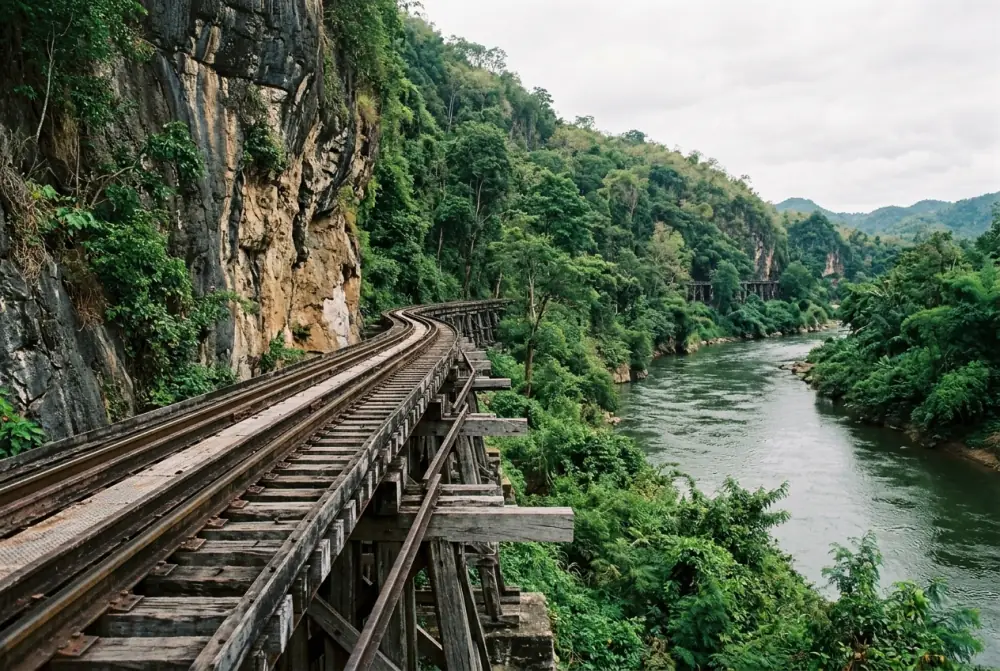
Judged as a ride, the interesting part is not the Bangkok leg at all. It is the section beyond Kanchanaburi, where the line crosses the Tham Krasae (Wang Pho) viaduct — a curving wooden trestle built by Allied prisoners, pinned to a limestone cliff with the Kwai Noi directly below. Trains slow to a crawl across it. That viaduct sits over an hour past Kanchanaburi town, which is why the train works far better as a day excursion from Kanchanaburi than as a way of getting there: you ride out, see the viaduct, and come back. Coming from Bangkok, the views are on the left-hand side of the carriage. What the railway was and who built it, along with the Kanchanaburi–Nam Tok departure times you would use for that day out, belongs to the Death Railway chapter.
The weekend excursion train is the exception to everything above: numbered 909 outbound and 910 back, it runs Saturdays, Sundays and public holidays only, and it starts from Hua Lamphong, not Thonburi — 06:30 out, back into Hua Lamphong at 19:30. It is reported at 120 THB in third class or 240 THB in air-conditioned second class and, unlike the ordinary trains, it must be reserved in advance at any station or through the SRT D-Ticket app. Thirteen hours end to end buys you a stretch of line you can reach in about an hour from Kanchanaburi town, on the same rolling stock. As a way of arriving it is the worst option on this page, and as a day out it only makes sense if sitting on the train all day is itself the thing you came for. Otherwise ride it from Kanchanaburi.
Give your flight number, not just an arrival time
Neither airport has a bus or a train towards Kanchanaburi, so an arrival by air is a road transfer however you arrange it, and the first hour of it is city driving in both cases — west out of Bangkok along Borommaratchachonnani and Highway 338, with nothing that behaves like an open road until Nakhon Pathom. Distances from each airport are in the orientation chapter, which also explains why Don Mueang is the better of the two Bangkok airports to land at if your flights give you the choice; the door-to-door times in the comparison table above already include the crawl out of the city.
The pickup itself is unremarkable and should be. At Suvarnabhumi the driver meets you on Level 4, the departures level, at Gate 4, where cars are allowed to stop; at Don Mueang it is Level 3, the departures level, and the exact door comes with your confirmation. There are 60 minutes of free waiting after landing — enough to cover immigration and baggage on a normal day. At Don Mueang, international flights land at Terminal 1 and domestic flights at Terminal 2, which are separate buildings, so give your flight number when booking rather than just an arrival time: a person checks it before the driver sets off, so the car is at the right building and a delay moves the pickup.
The last van back leaves at 19:00, the last train at 14:43
Coming out of Bangkok you have options until eight in the evening. Going back you do not, and this is the single most common planning mistake on this route.
- Last minivan from Kanchanaburi bus terminal: 19:00. That is the last departure to Sai Tai Mai, to Mochit New Van Terminal and to Chatuchak Park BTS alike. The first is 04:00 (03:30 for the Chatuchak Park service), with roughly 27 departures a day, so daytime frequency is not the issue — the evening cut-off is. The 19:00 is what the operator's own timetable publishes. One third-party listing of the same operator shows a 19:30, and no source confirms a later departure by anyone; since the whole case for pre-booking a car rests on that hour, plan on 19:00 and treat a 19:30 as a bonus if it exists.
- Last through train to Bangkok: 14:43. Train 258 leaves Kanchanaburi at 14:43 and reaches Thonburi at 17:40. The only other through service is train 260, which leaves at 07:05. There is no evening train, at all.
If you miss the 19:00 van, there is no scheduled public service to Bangkok until the small hours of the next morning. Ride-hailing in Kanchanaburi is set up for short hops around town, and matching a driver for a 130 km night run to Bangkok is not something to plan around. The realistic answers are a private car arranged in advance, or a night in Kanchanaburi and an early start.
How do you get around without a car?
Kanchanaburi province is long. The town is one thing; the waterfalls, Sai Yok and Sangkhlaburi are separate destinations an hour to four hours further up Highway 323, and no single base puts you close to all of them. The geography is set out in the orientation chapter; what matters here is that local transport is built for the town, not for the province.
In town, walk. The guesthouse, bar and restaurant strip along Mae Nam Khwae Road covers end to end in about twenty minutes. You only need wheels for three places: the bus terminal, the railway station, and the bridge about 5 km north.
Songthaews — small orange and large yellow pickups — run a fixed route up and down Saeng Chuto Road linking those three points. The local fare is a flat 10 THB. Drivers frequently quote tourists 40 THB per person for the Mae Nam Khwae to bus station run, so agree the price before you get in. Motorbike taxis run to about 50 THB within town; tuk-tuks and chartered songthaews want 40–100 THB and are all negotiable.
Motorbike hire is 200–300 THB a day, with 250 THB typical for a 125cc automatic, from shops clustered along River Kwai Road. Expect a 1,000 THB cash deposit plus a photocopy of your passport — hand over the copy, not the passport itself. An International Driving Permit with a motorcycle endorsement is legally required to ride in Thailand, and without one an insurer has grounds to decline a claim. Bicycles rent from about 50 THB a day and are fine for the town and the bridge, and no use at all on Highway 323. Grab operates in Kanchanaburi and is worth having on your phone if only as a price reference, though drivers are thin first thing in the morning; Bolt claims nationwide coverage but its provincial driver density is not something independent testing has confirmed.
Getting out of town without a car is possible for two of the four zones and not for the rest. Local bus 8170 runs from Kanchanaburi bus terminal to Erawan National Park for 60 THB (about USD 1.80), taking around an hour and a half, first bus 08:00. Sangkhlaburi-bound buses head up Highway 323 roughly every 30 minutes from about 06:00 to 18:30 and will drop you at Sai Yok Noi, at Hellfire Pass and at the Sai Yok National Park turn-off — the car-free route most guides omit entirely. Huay Mae Khamin has no public transport of any kind: the nearest bus ends at Erawan, over an hour short.
For the full run to Sangkhlaburi, 220 km up the same highway, the sources do not agree with one another and there is no way to reconcile them: fares are reported anywhere between roughly 110 and 220 THB, and journey times between 3.5 and 5 hours, depending on which listing and which service. That is a spread, not a fare. Budget the upper end of both, confirm the price at the terminal counter on the day you travel, and do not plan an onward connection on the assumption of the low end. Chapter 6 is where you decide whether the ride is worth making at all.